mhtintstudio@gmail.com+60162471894
MH Tint Studio
  • Home
  • Services
    TintWrappingPPFPolish Coating
  • Gallery
  • About Us
  • Blog
  • Contact
Appointment
MH Tint Studio
+60162471894mhtintstudio@gmail.com
Home
TintWrappingPPFPolish Coating
GalleryAbout UsBlogContact
Appointment
WhatsApp
Call Now
Available 24 / 7

Get A Free Quote

Malaysia's most trusted car care studio — fast, professional, and just one message away. Let's protect your ride today.

Free consultation
Same-day response
5-star service
Expert technicians
What's App UsCall UsAppointment Now
Get a free quote from MH Tint Studio
100%
Satisfaction
Guaranteed
Fast Response< 1 Hour reply
Live

Make an Appointment

Pick your time — we'll handle the rest

Book Now
MH Tint Studio logo

MH Tint Studio specializes in premium window tinting services, offering expert installation and a wide range of high-quality tint options for vehicles.

+60162471894

Call for consultation

mhtintstudio@gmail.com

Our Services

  • Tint
  • Wrapping
  • PPF
  • Polish Coating

No. 13 (Ground Floor, Jalan Equine 9, Taman Equine, 43300 Seri Kembangan, Selangor, Malaysia

220-G, Jalan Mahkota, Maluri, 55100 Kuala Lumpur, Wilayah Persekutuan Kuala Lumpur, Malaysia

Quick Links

  • About Us
  • Privacy Policy
  • Contact Us
  • Portfolio Gallery
  • Popular Articles

Outlet 01

MH Tint Studio — Seri Kembangan

Outlet 02

MH Tint Studio — Maluri Cheras

Business Hours

Open Now
  • Monday09:00 to 19:00
  • Tuesday09:00 to 19:00
  • Wednesday09:00 to 19:00
  • Thursday09:00 to 19:00
  • Friday09:00 to 19:00
  • Saturday09:00 to 19:00
  • Sunday09:00 to 19:00
All times in local timezone

© 2026 MH Tint Studio. All rights reserved.

Powered byDigital Resolution

How Ceramic Coating Keeps Your Car in Kuala Lumpur Looking New
Back to Blog

How Ceramic Coating Keeps Your Car in Kuala Lumpur Looking New

MH Tint16 May 20267 min read
How Ceramic Coating Keeps Your Car in Kuala Lumpur Looking New

How Ceramic Coating Keeps Your Car in Kuala Lumpur Looking New

Navigating the bustling streets of Kuala Lumpur is a true test of endurance for any vehicle's exterior paintwork. Whether you are stuck in peak-hour gridlock along Jalan Tun Razak, speeding through a sudden afternoon monsoon on the Sprint Highway, or parking in open-air bays across Bangsar, your car is constantly exposed to aggressive environmental degradation.

The tropical climate of the Klang Valley presents a relentless trifecta of paint hazards: blistering ultraviolet (UV) radiation, high relative humidity, and highly acidic urban rainfall.

Traditional automotive waxes and spray sealants simply cannot withstand these local conditions. Within weeks, the equatorial heat melts away these temporary organic barriers, leaving your factory clear coat bare against atmospheric hazards.

To maintain an immaculate, mirror-like showroom finish over the long term, automotive enthusiasts and luxury car owners across Malaysia rely on advanced Nano-Ceramic Coating Technology. This semi-permanent liquid polymer creates a high-density molecular barrier that redefines car care in the tropics.

The Threat Matrix: Why KL Driving Ruins Factory Paint

To appreciate the protective power of a ceramic coating, it is vital to analyze the exact environmental factors that destroy a vehicle's clear coat across Kuala Lumpur.

  • Intense Solar Radiation and Color Fading: Located just a few degrees north of the equator, KL experiences exceptionally high UV index ratings year-round. This relentless solar energy penetrates the clear coat, breaking down paint molecules through chemical oxidation. Over time, this leads to a dull, faded, or chalky surface appearance—especially noticeable on dark or vibrant paint finishes.
  • Urban Acid Rain and Chemical Etching: As a massive metropolis, Kuala Lumpur’s air traps heavy concentrations of nitrogen oxides and sulfur dioxide from industrial emissions and dense traffic. When mixed with rain, it creates an acidic solution. If left to dry under the sun on your car panels, this acid rain chemically etches deep water spot rings into the clear coat.
  • Corrosive Organic Fallout: Tropical urban life brings large populations of birds and insects. Bird droppings and tree sap contain complex organic acids. When baked onto a hot car bonnet under 35-degree heat, these substances can eat through factory clear coat down to the base primer within 24 to 48 hours.

The Chemistry of Nano-Ceramic Protection

Ceramic coatings do not simply sit on top of the paint like a traditional wax layer. Instead, they leverage the power of molecular nanotechnology.

Most premium coatings are formulated with high concentrations of Silicon Dioxide ($SiO_2$) or Silicon Carbide ($SiC$) suspended in liquid nano-carriers.

When a professional detailing technician applies this liquid to a polished panel, the microscopically tiny nanoparticles seep directly into the microscopic pores, valleys, and structural unevenness of the factory clear coat. As the carrier solvents evaporate, the active components chemically cross-link with the paint molecules, curing into an ultra-dense, semi-permanent glass-like crystalline shield.

This new layer typically registers up to 9H or 10H on the Pencil Hardness Scale (ASTM D3363). While it does not make a vehicle completely bulletproof or scratch-proof against deep vandalism, it drastically hardens the surface tension, providing a hard sacrificial layer that absorbs everyday abrasion.

Key Performance Advantages for Kuala Lumpur Vehicles

Applying a high-grade ceramic nano-coating completely changes how your vehicle interacts with the harsh local climate and urban road conditions.

  • Extreme Hydrophobic Water Beading: The perfectly flat, slick top coat of a ceramic layer drastically reduces surface tension. Water cannot flatten out on the panel; instead, it beads into tight, uniform droplets that slide off effortlessly at speeds above 50 km/h. This rapid shedding action prevents dirty puddle water and rain from leaving mineral deposits behind.
  • The "Self-Cleaning" Phenomenon: Because road grime, brake dust, and oily soot struggle to find a texture to grip on the hydrophobic surface, they remain loosely suspended on the ceramic topcoat. When it rains heavily, the rolling water beads gather up this surface dirt and wash it away, allowing the car to stay cleaner for significantly longer periods between washes.
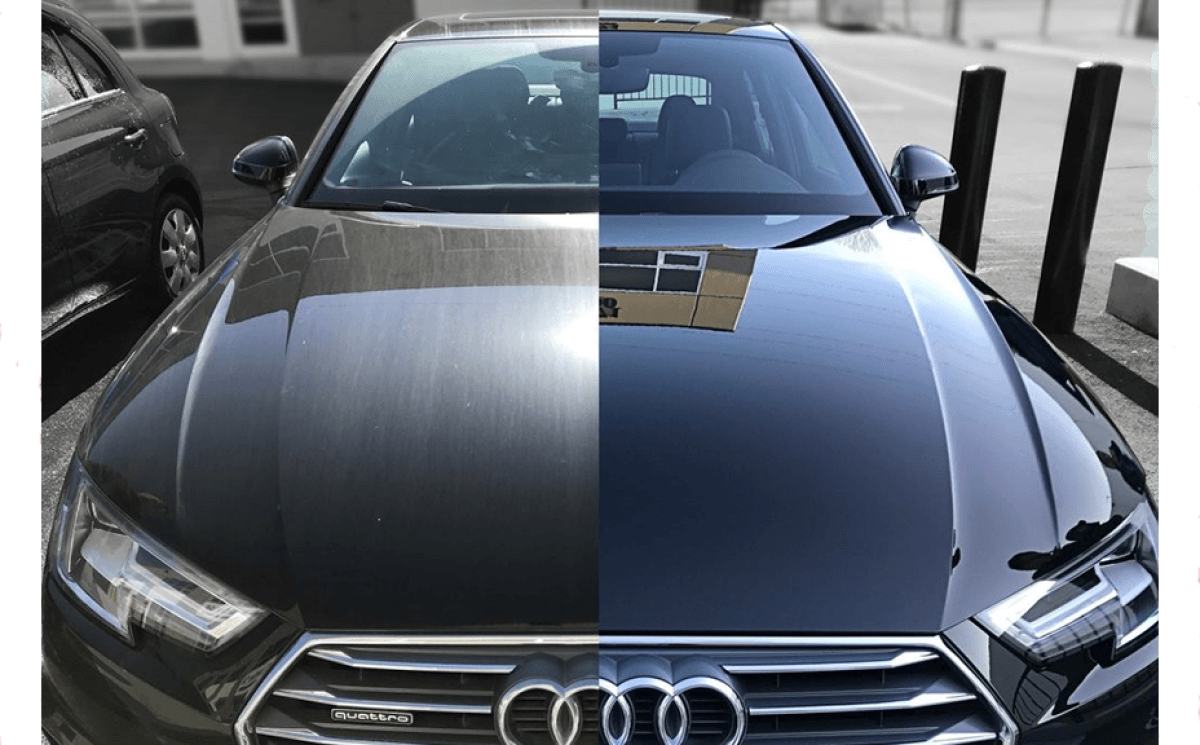
  • Permanent High-Gloss Depth: The optical transparency of the cured quartz layer fills in microscopic paint imperfections, creating a uniform plane for light reflection. This provides a deep, wet-look gloss that maximizes the metallic flake pop on premium executive sedans and supercars, eliminating the need for regular polishing.
  • Robust Chemical and Thermal Resistance: The cured inorganic ceramic matrix is chemically inert. It can withstand highly alkaline car soaps and acidic contaminants alike, neutralizing the etching capabilities of bird droppings or industrial fallout before they can reach the sensitive factory paint layer.

Comparison: Ceramic Coating vs. Standard Maintenance Waxes

Performance AttributeTraditional Carnauba Wax / SealantAdvanced Nano-Ceramic Coating
Bonding CharacteristicTemporary physical adhesion on surface.Semi-permanent chemical cross-linking.
Melting Point ThresholdLow (degrades rapidly above 60°C panel heat).Extremely high (withstands up to 500°C temperatures).
Hydrophobic Contact AngleModerate (approx. 90° water beading).Super-high (exceeds 110° hyper-beading).
Resilience to Car Wash ChemicalStripped away by alkaline or heavy soaps.High resistance to pH 2 through pH 12 chemicals.
Average Functional Lifespan4 to 8 weeks before requiring reapplication.2 to 5+ years backed by detailing studio warranties.

Meticulous Application: Why Professional Prep Matters

A common misconception is that the ceramic coating itself fixes paint defects. In reality, a ceramic coating acts as a permanent clear lens over your paint—it locks in and highlights whatever condition lies beneath it.

Achieving a flawless, long-lasting installation requires an air-filtered, climate-controlled detailing bay and an intensive preparation workflow:

  • Chemical and Mechanical Decontamination: The vehicle undergoes an iron-fallout chemical wash to dissolve embedded metallic brake particles, followed by an intensive mechanical clay bar treatment to strip out embedded road tar and industrial soot from the clear coat pores.
  • Multi-Stage Machine Paint Correction: Skilled detailers use dual-action rotary polishers with varying grades of compound pads to level out fine wash swirls, cobweb scratches, and historical oxidation. The objective is to bring the factory paint to near-perfect structural clarity.
  • Isopropyl Alcohol Panel Stripping: The entire car is wiped down with an Isopropyl Alcohol (IPA) panel prep spray. This dissolves any leftover polishing oils, lubricants, or fillers, ensuring the bare clear coat is completely clean so the ceramic molecules can achieve maximum chemical cross-linking.
  • Precision Application and Curing: The coating is applied evenly block-by-block using specialized applicator pads. The technician monitors the "flashing" time (when the solvent begins to evaporate) before leveling and buffing the residue with ultra-plush microfiber towels. Finally, the car is cured under short-wave infrared heat lamps to bake and lock the ceramic matrix onto the bodywork.

Post-Coating Care Guidelines for the Tropical Climate

While a ceramic coating drastically reduces the effort required to clean your car, maintaining proper maintenance habits keeps the hydrophobic top coat operating at peak efficiency.

  • Implement a Strict Hand-Wash Policy: Never take a ceramic-coated car through a mechanical drive-through wash. The fast-moving, dirty nylon brushes will scratch the coating and ruin the gloss. Always use a manual two-bucket hand wash technique equipped with bottom grit guards.
  • Use Only Safe pH-Neutral Shampoos: Avoid cheap car soaps containing harsh degreasers, dish soaps, or gloss-enhancing waxes. Heavy chemical cleaners can degrade the hydrophobic layer, while wax residues clog the ceramic surface, diminishing its water-beading performance.
  • Dry Safely with Premium Microfiber: After washing, do not let the vehicle air dry under the hot sun, as this can still form mineral spots from hard tap water. Dry the car using an ultra-absorbent, high-GSM microfiber towel or a dedicated automotive air blower.
  • Apply Periodic Maintenance Boosters: Every 6 to 12 months, apply a dedicated SiO2-based ceramic maintenance spray or booster. This simple step rejuvenates the top sacrificial layer, removes bound minerals, and ensures the slickness and water-repelling traits remain flawless for years to come.
All PostsPublished 16 May 2026